
Author: Muhammad Faheem
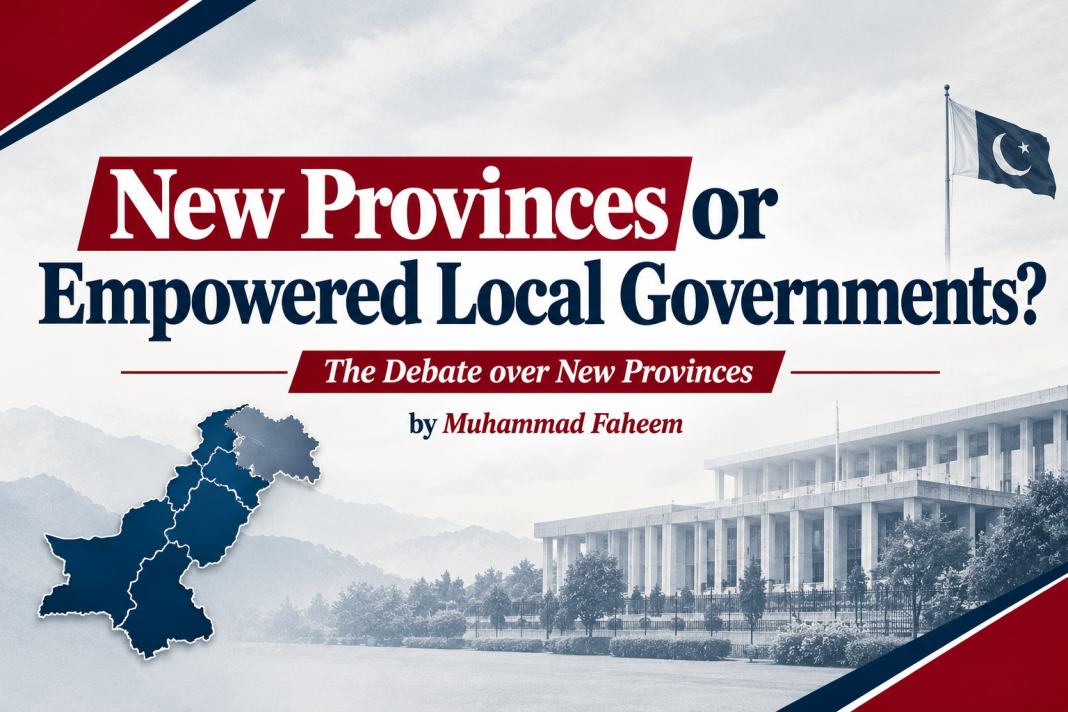
Pakistan’s renewed debate over the creation of new provinces raises a fundamental question: Is the country’s governance crisis primarily the result of having too few provinces, or does it reflect the failure to establish strong, empowered and accountable local governments? While the demand for new provinces is often presented as a solution to administrative difficulties, regional grievances and unequal development, the underlying problem may be much deeper. Pakistan has struggled for decades to bring government closer to ordinary citizens, particularly those living in remote districts, rural communities and areas far from provincial capitals.
In many cases, major cities receive greater political attention, administrative resources and development investment, while smaller towns and distant districts struggle to secure adequate public services. Citizens in these areas may face difficulties accessing healthcare, education, clean drinking water, municipal services and government offices. Such disparities can generate a sense of political and economic exclusion, strengthening demands for separate administrative units.
However, creating new provinces does not automatically guarantee better governance. A smaller province may bring the provincial headquarters closer to some communities, but if decision-making, financial resources and administrative authority remain concentrated in the hands of provincial governments and political elites, the fundamental problems may persist. The creation of additional provinces could simply reproduce the existing governance structure on a smaller scale.
The real question, therefore, is whether Pakistan needs more provincial governments or a more effective system of governance that gives citizens meaningful access to decision-making at the grassroots level.
Local Governments: The Missing Link in Democracy
One of the most significant weaknesses in Pakistan’s democratic development has been the inconsistent establishment of genuinely empowered local governments. Although political parties frequently emphasise democracy, representation and public participation, elected local institutions have often struggled to obtain the financial, administrative and political authority necessary to perform their responsibilities effectively.
Article 140-A of the Constitution requires provincial governments to establish local government systems and devolve political, administrative and financial responsibility and authority to elected representatives. Yet the implementation of this constitutional principle has remained a persistent challenge. The existence of local elections alone cannot ensure effective decentralization if elected representatives lack control over budgets, development priorities and administrative decisions.
Pakistan’s political history provides an interesting contrast. Ayub Khan introduced the Basic Democracies system, Zia-ul-Haq established local bodies, and Pervez Musharraf introduced the Devolution of Power Plan in 2001. These arrangements created structures for local representation and administration, and the Musharraf-era system, in particular, gave elected district leadership a significant role in local governance. However, these systems also operated under military governments and served broader political purposes. Their administrative features must therefore be considered separately from questions of democratic legitimacy and political accountability.
The important lesson is that local governance can be organized around institutions that are closer to citizens, but sustaining an effective and democratically accountable system requires long-term political commitment. Under successive democratic governments, local institutions have frequently faced interruptions, changes in legal frameworks and limitations on their authority. One structural concern is the influence of members of national and provincial assemblies over development resources. When elected legislators retain substantial control over local development spending, they may have limited incentives to transfer meaningful financial and administrative authority to local governments.
This arrangement can weaken grassroots democracy. Instead of citizens approaching an elected local institution with the authority and resources to resolve their problems, they may become dependent on provincial departments or individual legislators. The result can be a system in which access to public services depends heavily on political connections rather than transparent institutional procedures.
Strong local governments could help change this relationship by giving citizens a direct mechanism to influence development priorities and hold local representatives accountable. A community should not have to rely exclusively on its provincial capital to secure a functioning water supply scheme, repair a local road or improve basic municipal services.
Decentralization before Redrawing the Map
The demand for new provinces should not be dismissed. Questions of regional identity, political representation, administrative accessibility and unequal development are legitimate subjects of democratic debate. Smaller administrative units may offer certain advantages, depending on their institutional design, financial viability and distribution of responsibilities. Nevertheless, the creation of new provinces should not be treated as a substitute for meaningful decentralization.
A smaller province is not necessarily a more democratic or efficient province. If its government retains excessive control over local budgets, appointments and development decisions, communities outside the new provincial capital may continue to experience the same administrative distance and political exclusion. Changing provincial boundaries without changing the distribution of authority could leave the underlying governance problem unresolved.
Pakistan should therefore place the strengthening of local governments at the center of its governance reform agenda. Elected local institutions need predictable financial resources, clearly defined administrative responsibilities and the authority to make decisions according to the needs of their communities. They must also be protected from arbitrary interference and allowed to complete their legally prescribed terms. Transparent budgeting, public participation and effective accountability mechanisms are equally essential.
A meaningful decentralisation framework would allow citizens to hold local representatives directly responsible for the services and development projects within their jurisdiction. It would also reduce unnecessary dependence on provincial capitals and enable governments to respond more effectively to the needs of geographically distant communities.
If Pakistan had developed strong, financially autonomous and democratically accountable local governments, many of the grievances currently contributing to demands for new provinces might have been reduced. This does not mean that provincial restructuring would never be necessary. It means that the country should first confront a fundamental question: why have existing provincial systems struggled to transfer sufficient authority to the people and communities they are supposed to serve?
Ultimately, the purpose of government is not to create more administrative headquarters or redraw political boundaries. It is to deliver public services, ensure equitable development and make institutions accountable to citizens. Pakistan can continue debating the creation of new provinces, but it must not overlook the institution that brings democracy closest to ordinary people.
Before creating more provinces, Pakistan must seriously consider whether it has fully empowered the local governments it already needs.