

Author: Abdullah Shah
Pakistan’s political landscape is once again moving toward a period of heightened tension as the Pakistan Tehreek-e-Insaf (PTI) prepares for a planned march toward Islamabad on September 27. With security preparations intensifying across the capital and neighbouring areas, the coming days are likely to test both the government’s approach to maintaining public order and the opposition’s ability to organise a large-scale political mobilisation without causing prolonged disruption to daily life.
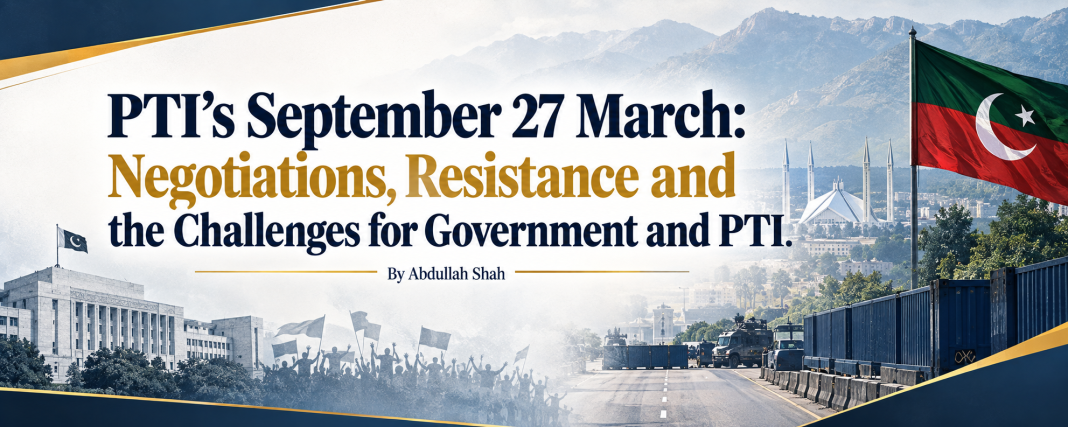
Recent reports indicate that Islamabad and Rawalpindi are preparing for the possible arrival of thousands of protesters. More than 2,000 containers have reportedly been moved to strategic locations, while police authorities have sought additional personnel, equipment and funds. Police estimates cited in recent reports put the potential number of protesters reaching Islamabad at between 20,000 and 25,000.
The preparations extend beyond roadblocks and security deployments. Twenty-four educational institutions in Islamabad are reportedly being used to accommodate security personnel, resulting in the closure of those institutions during the heightened security period.
The developments raise a question that goes beyond the immediate confrontation between the government and PTI: can the right to political protest be exercised while protecting the normal functioning of the capital?
PTI’s mobilisation strategy
The PTI’s September 27 mobilisation is centred on demands including the release of former Prime Minister Imran Khan. Party leaders and supporters have been preparing for a major political gathering, while details concerning the movement of caravans, participation from different districts and routes toward Islamabad have continued to develop.
Reports attributed to party sources suggest that members of the party’s parliamentary structures have been asked to mobilise supporters from their respective constituencies. However, some operational details remain subject to decisions by the party leadership and developments on the ground.
There have also been reports that PTI caravans could move toward Islamabad in stages rather than arriving simultaneously. The possibility of a temporary stopover in Swabi in the event of administrative obstacles has also been discussed. Until the party formally announces its final arrangements, however, individual proposals should not be treated as a confirmed strategy.
The central challenge for PTI is therefore organisational as much as political: how effectively can it mobilise supporters while maintaining control over a large movement involving multiple routes and thousands of participants?
Government prepares for a major security operation
The government and Islamabad administration have responded with extensive security preparations.
According to reports, Islamabad Police have requested thousands of additional personnel and anti-riot equipment from other provinces. Authorities have also reportedly sought hundreds of millions of rupees to cover expenses related to accommodation, transportation, containers, equipment and other logistical requirements.
More than 2,000 containers have reportedly been positioned at key points in Islamabad and Attock, with additional barriers planned for major roads, sensitive locations and entry points to the capital.
For the authorities, the immediate priority is maintaining law and order and protecting sensitive government installations. For residents, however, extensive security measures can create another set of problems: blocked roads, disrupted transport, restricted movement and uncertainty over access to schools, offices and businesses.
That tension between security requirements and ordinary civic life is likely to remain one of the defining issues surrounding the September 27 mobilisation.
The right to protest versus the right to move
Political protest is an established feature of Pakistan’s democratic politics. Successive governments and opposition parties have witnessed or organised rallies, sit-ins, marches and demonstrations.
The difficulty arises when a protest affects essential infrastructure and the routine functioning of a major city.
Islamabad is not simply another urban centre. It houses Parliament, federal ministries, diplomatic missions, government offices, educational institutions and major commercial and residential areas. A large-scale disruption can therefore have consequences well beyond the immediate protest site.
The challenge for the authorities is to maintain public order without unnecessarily restricting lawful political activity. At the same time, political parties face the responsibility of ensuring that their demonstrations remain peaceful and that the rights and mobility of other citizens are not unnecessarily compromised.
The manner in which both sides approach this balance could be as important as the size of the protest itself.
Political tensions deepen
The political environment has become more sensitive in recent days following arrests of members of Imran Khan’s family.
Aleema Khan was arrested in Lahore on September 20 ahead of the planned protest, according to PTI and reporting by Reuters. Authorities said she was detained for 30 days on public-safety grounds, while PTI objected to the action.
Reports subsequently emerged concerning the detention of Imran Khan’s sisters Uzma Khanum and Noreen Niazi. Their arrests have drawn criticism from PTI and supporters, while authorities have linked the measures to public-order concerns.
These developments have added another layer of tension to an already polarised political environment. Because the political interpretation of such actions differs sharply between the government and PTI, claims concerning motives should be attributed to the relevant parties rather than presented as established fact.
The Islamabad High Court has also become involved in the broader dispute. On September 22, the court summoned the Islamabad police operations chief in connection with allegations of harassment of PTI leaders and raids on their homes.
The economic backdrop
The political confrontation is unfolding against a difficult economic backdrop.
On September 22, the government increased the price of petrol by Rs4.61 per litre to Rs393.75, while reducing the price of high-speed diesel by Rs1.96 to Rs422.08 per litre, according to the Petroleum Division.
Fuel prices matter because they influence transportation and logistics costs and can feed into the prices of goods and services. For households already dealing with high living costs, changes in fuel prices can therefore become an important part of the broader political debate.
At the same time, public opinion cannot be reduced to a single economic indicator. Political performance, government policies, opposition strategy, local issues and broader economic conditions all contribute to how citizens assess political developments.
For the government, the economic challenge is therefore running alongside the political one: managing public expectations while dealing with continued political confrontation.
Protest and the digital information battlefield
Another defining feature of the current political environment is the role of digital media.
Unlike previous political protests, when information travelled primarily through newspapers, television and radio, today’s demonstrations unfold in real time through social media, livestreams, mobile phones and online news platforms.
This provides citizens with rapid access to information, but it also creates opportunities for misinformation to spread quickly. Old videos can be presented as current footage, unverified claims can circulate widely, and political statements can be detached from their original context.
During the September 27 mobilisation, claims concerning road closures, arrests, the size of political caravans, security operations and statements by political leaders are likely to circulate rapidly.
Verification will therefore be critical. News organisations, political parties and individual social-media users all have a role in distinguishing confirmed information from claims that remain unverified.
Could negotiations reduce the tension?
With the government preparing extensively for the protest and PTI continuing its mobilisation, political dialogue remains one possible avenue for reducing uncertainty.
Direct negotiations or parliamentary engagement could potentially address issues such as protest routes, the duration and scope of demonstrations, access for emergency services, traffic arrangements and the political demands being raised by the opposition.
Dialogue would not necessarily resolve the underlying political disagreements. However, establishing agreed procedures for political activity could reduce the likelihood of confrontation and help protect ordinary citizens from unnecessary disruption.
The alternative is a cycle in which mobilisation leads to tighter security measures, tighter security measures produce further political confrontation, and confrontation creates additional pressure on businesses, commuters and public institutions.
The economic cost of disruption
The economic impact of a major political protest depends on its duration, intensity, geographical spread and the extent to which commercial and transportation activity is disrupted.
If major highways remain open and businesses continue operating, the economic impact may be limited. If key roads are blocked for extended periods, however, transportation, deliveries, retail activity and employee attendance can all be affected.
For Islamabad and Rawalpindi, the consequences can extend beyond the two cities because the twin cities serve as an important connection between Punjab, Khyber Pakhtunkhwa and other parts of the country.
This makes traffic management particularly important. Any prolonged disruption to major arteries could affect commuters, freight movement and intercity travel.
What comes next?
The days leading up to September 27 will likely determine whether the confrontation develops primarily as a political mobilisation, a security challenge, a negotiated protest or some combination of all three.
For PTI, the immediate task is to demonstrate organisational strength and maintain momentum around its political demands.
For the government, the challenge is to maintain security while ensuring that the capital does not become paralysed.
For citizens, the most immediate concern is more practical: whether they will be able to travel, work, study and conduct their daily affairs without prolonged disruption.
Ultimately, the significance of September 27 will not be measured only by the number of protesters who reach Islamabad. It will also depend on how political leaders, the administration and security authorities respond to one another—and whether space remains for dialogue alongside political mobilisation.