
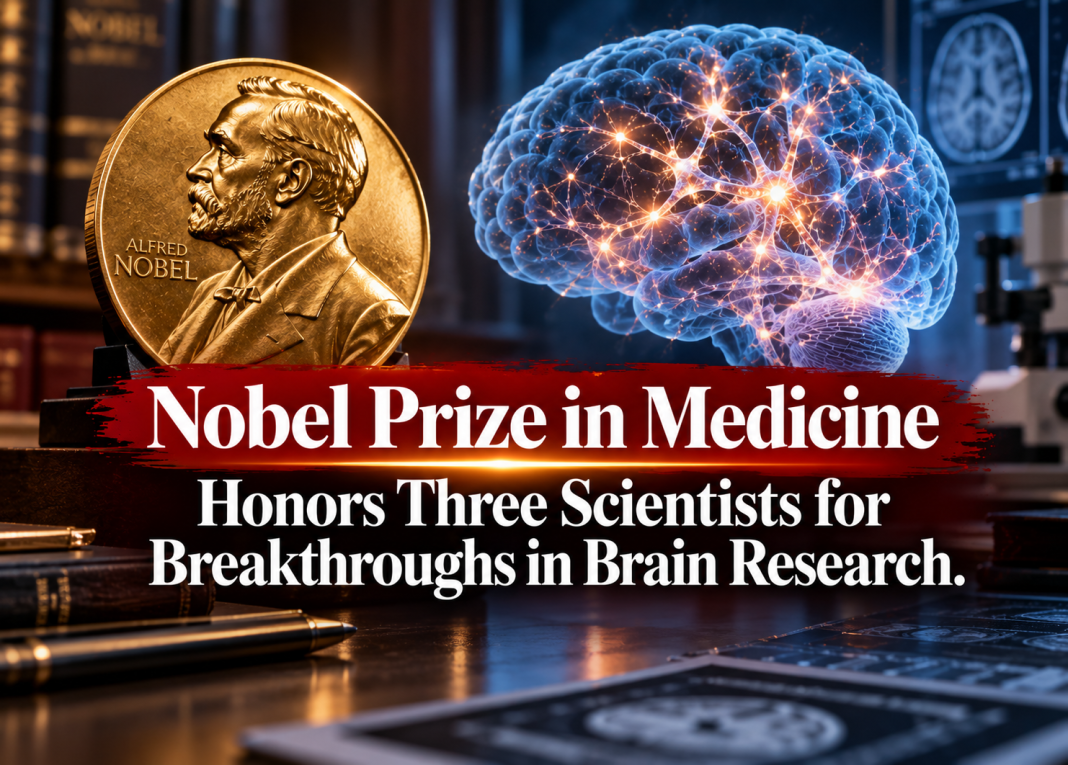

The 2026 Nobel Prize in Physiology or Medicine has been awarded to three scientists whose research into the brain and its neural mechanisms helped establish optogenetics, a technique that allows scientists to control and study nerve cells using light.
The laureates are American scientist Karl Deisseroth and German researchers Peter Hegemann and Georg Nagel, according to the Nobel Committee.
The committee said the scientists’ work on light-sensitive proteins and the interaction between genes and neural cells provided new tools for investigating how the brain regulates memory, emotions and behavior.
Hegemann and Nagel discovered the light-sensitive protein channelrhodopsin, a breakthrough that laid the foundation for optogenetics. Deisseroth later helped transform the discovery into a practical tool that enabled researchers to use light as a switch for controlling specific neurons.
The technique has become an important research tool in neuroscience, allowing scientists to examine the activity of individual groups of nerve cells and explore the biological mechanisms underlying complex brain functions.
The prize money of 12 million Swedish kronor will be divided equally among the three laureates.
The Medicine prize opens this year’s Nobel announcements. The Physics prize is scheduled for Oct. 6, followed by Chemistry on Oct. 7 and Literature on Oct. 8. The Nobel Peace Prize will be announced Oct. 9, while the Economics prize is due on Oct. 12.
In 2024, the Nobel Committee awarded the Medicine prize to three scientists for discoveries that advanced understanding of the immune system and its functions.